
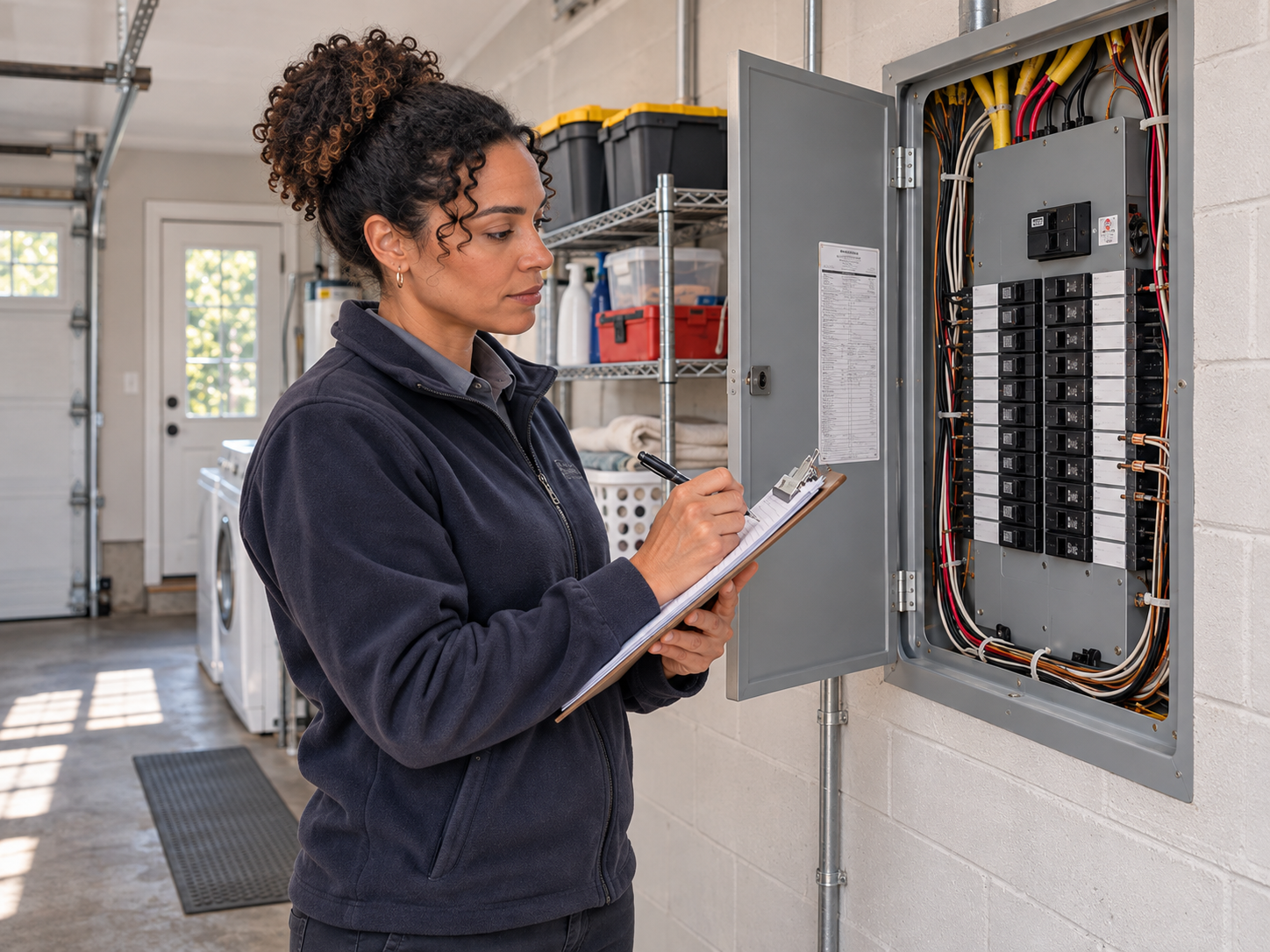
Before paying for a larger panel, understand what your home actually needs—and what alternatives may be available.
You’re ready to install an EV charger at home. Then the electrician’s estimate includes something you hadn’t budgeted for: replacing your electrical panel. Suddenly, what seemed like a straightforward project has become a much bigger decision.
That recommendation may be entirely justified. Adding an EV charger, heat pump, or induction range can reveal limitations in an older electrical system. But before approving an expensive upgrade, it’s reasonable to ask what specifically needs to change—and why.
A full breaker box does not necessarily mean your home lacks electrical capacity. And installing a larger panel does not, by itself, increase the power available from the utility. Understanding the difference can help you evaluate the proposal with confidence.
First, understand what you're being asked to replace
Three related terms are easy to confuse:
Electrical panel: The box that distributes electricity through your home and contains circuit breakers.
Electrical load capacity: The amount of electrical demand your system can safely support, as determined by an appropriate assessment—not simply the number of unused breaker spaces.
Utility electrical service: The connection and associated equipment supplying power to your property, which may have its own capacity limits.
A panel can be physically full but have adequate capacity for another load if an approved configuration is possible. Conversely, empty breaker spaces do not prove that the service can support a high-demand appliance. A licensed electrician should evaluate both, along with the panel’s condition.
Why a 100-amp panel isn't an automatic dealbreaker
Some older Northern California homes have 100-amp electrical service; many newer homes have 200-amp service. The rating alone does not settle whether an upgrade is required.
A licensed electrician can perform a code-compliant load calculation that accounts for the home's existing equipment and planned additions. Where permitted, an approved method using historical demand information may also be relevant.
The result may show that an upgrade is needed. Or it may reveal a safe way to accommodate the new equipment without increasing service capacity.
Four alternatives worth asking about
Equipment with lower electrical demand. An EV owner who drives modest daily distances may not require the fastest home charging arrangement. Some appliances also offer configurations with different electrical needs. A professional can help evaluate whether those choices match your household and installation.
Electrical load management. Properly designed and listed equipment can reduce or temporarily pause a load—such as EV charging—when other appliances need power. This can sometimes help keep total electrical demand within a system's approved limits. Compatibility, installation, and code acceptance must be evaluated by a licensed electrician.
Approved circuit-sharing systems. Some listed devices can coordinate two compatible high-demand appliances so they do not operate on the shared circuit at the same time. This is not permission to use an ordinary outlet splitter or connect appliances to an undersized circuit. A qualified professional must determine whether the equipment and circuit are suitable.
Reconfiguring the existing panel. In certain installations, an electrician may be able to rearrange circuits or use breakers specifically approved for that panel. Creating an empty breaker position does not create additional electrical capacity, and not every panel can be safely reconfigured.
None of these options is a DIY electrical project. A licensed electrician must assess the specific home, required permits, manufacturer instructions, and applicable electrical codes.
When an upgrade really does make sense
Replacing or upgrading equipment may be necessary when a load calculation shows insufficient capacity, the panel is unsafe or deteriorated, approved alternatives cannot support the planned work, or future electrical improvements justify additional capacity.
Warning signs such as overheating, burning odors, arcing, or recurring electrical problems require prompt professional attention. Do not remove covers or attempt to inspect energized equipment yourself.
The objective is not to avoid an upgrade at all costs. It is to make the right safety and investment decision.
What might the upgrade cost?
The California Energy Commission's homeowner guidance cites approximately $2,000–$6,000 for a panel upgrade, depending on the home. This is a broad planning reference—not a current quote for your neighborhood or a guarantee that your project will fall within that range.
Utility work, new wiring, permits, and related repairs can change the total substantially. Ask that estimates distinguish panel replacement from electrical service upgrades and other associated work.
Five questions to ask before approving the work
What exactly makes my current system inadequate? Is it breaker space, load capacity, panel condition, or a utility-service limitation?
Have you completed a documented electrical load calculation? What does it show about my existing system and planned equipment?
Are there safe, code-compliant alternatives? Would load management, a different equipment configuration, or an approved panel reconfiguration work here?
What is included in the price? Does the estimate cover permits, inspection, wiring, utility coordination, and any necessary restoration?
How would my future plans affect the recommendation? If I later add other appliances or electrical equipment, would an upgrade now make more sense?
For a substantial project, a second assessment can be worthwhile. Verify contractors' licenses through the California Contractors State License Board.
The smartest upgrade starts with the right question
A larger electrical panel can be a valuable—and sometimes essential—improvement. But the best decision starts with understanding your home's actual electrical requirements.
Before committing to an upgrade, ask for the professional assessment that explains why it is necessary and whether another safe solution could meet your needs.
Additional Resources
ENERGY STAR — Make Your Home Electric Ready — Electrical readiness, EV charging, and potential alternatives.
California Energy Commission — Homeowner and Renter Energy Resources — California-specific electrical upgrade considerations and planning guidance.
California Contractors State License Board — Check a License — Verify a contractor's license before hiring.